


Silence or conversation during the massage?;
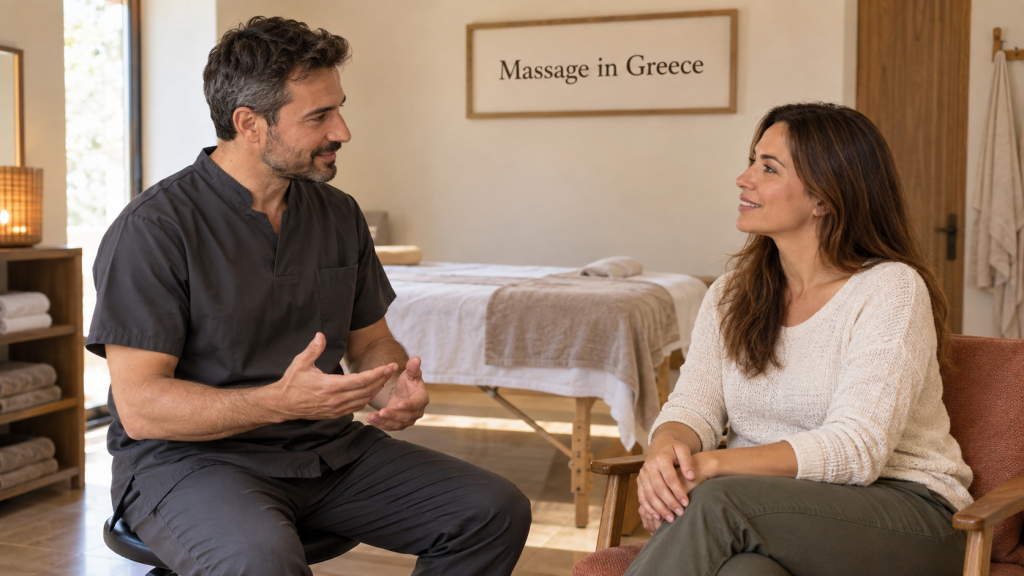
Not everyone relaxes in the same way. Some people may want to close their eyes and not speak at all. Others feel more comfortable exchanging a few words, especially on their first visit. The important thing isn’t to follow some unwritten rule. It’s that the client doesn’t feel like they have to talk to be polite or stay silent because «that’s how it’s done during a massage.».
Think about it: You’re lying down for a massage. You’ve set your cell phone aside, and, in theory, this is your moment to relax. And then the conversation starts. At first, you answer politely. Then comes another question. And another. Until you realize that, instead of letting go, you’re trying to keep up a conversation you probably never wanted to start in the first place.
Of course, the exact opposite is also true.
You walk into a place for the first time, you don’t know the professional, and the complete silence makes you feel even more awkward. A few simple words would help you feel more at ease.
So what's the deal, then?;
Should we talk or not during the massage?;
The answer is simpler than it seems: Not everyone needs the same thing to relax.
Not all people are the same, nor are all days
There are people who relax while talking.
Talking helps them overcome their initial awkwardness, get to know the professional a little better, and feel as though they are in a familiar environment.
There are also people who come for exactly the opposite reason.
For an hour, they don't want to explain, answer questions, or socialize. They just want to close their eyes and be left in peace.
And the same person might want to talk one day and not want to say a word the next.
That's not a contradiction. It's only human.
It's not about the conversation. It's about the obligation.
A calm, natural conversation doesn't necessarily ruin the experience. Just as silence doesn't mean that something is wrong.
The problem begins when the customer feels that they have to respond.
He should reply so as not to seem rude.
To keep the conversation going, even though he wants to close his eyes.
To laugh, make comments, and show interest when they've come to relax.
No one should have to «carry out» a social discussion during the session.
How does a professional figure out what the client wants?;
He doesn't have to guess.
He can start with a few casual remarks and observe. Does the customer willingly continue the conversation? Does he ask questions? Does he seem to enjoy talking?;
Or does he reply briefly, close his eyes, and let the conversation gradually fade away?;
Most people show what they need. All it takes is for someone to pay attention to them and not take their silence personally.
A simple phrase at the beginning of the session can break the ice:
«You can relax however you like. If you want to talk or if you need anything, I'm here.»
No rules. No need for the customer to formally request… permission to remain silent.
But there are some things that need to be said
The desire for quiet doesn't mean that all communication stops.
«Is the pressure okay?»
«Are you comfortable?»
«Do you want us to change something?»
These questions not It's unnecessary talk. It's part of the attention a session requires.
It’s just as important for the client to know that they can say if they’re cold, if the pressure doesn’t feel right, or if something is bothering them. They don’t have to put up with it just to avoid upsetting the professional.
A good experience can't be measured in words
The session isn't any better just because it took place in complete silence.
It isn't any warmer because there was a constant discussion.
It's good when the person there feels that they can just be themselves in that moment. To speak. To remain silent. To change their mind. To ask for something without feeling like they're being difficult or rude.
Because, after all, relaxation doesn't begin when the sounds stop.
It begins when we stop trying to live up to what we think others expect of us.
What do you prefer during a massage? Silence or a quiet conversation?;