


Professionalism is evident even before the session begins
We often believe that the quality of a massage is determined solely by technique: by the movements, the pressure, the understanding of the body, and the outcome of the session.
But for the person who makes an appointment, the experience actually began much earlier.
It begins the moment he starts looking for a professional. It starts with the way the professional presents himself, the information he finds, the first point of contact, and the impression he forms even before arriving at the location.
Professionalism in massage doesn't begin with the first touch. It begins with the first interaction.
A Clear Overview of the Service
Someone looking for a massage wants to understand exactly what is being offered.
What kind of massage is it?;
Who is it intended for?;
How long does it last?;
How much does it cost?;
How does the session proceed?;
Clear information does not make a service any less personal. On the contrary, create a sense of security.
Customers don't need grandiose promises. They need to know what they can actually expect. The more clearly a professional talks about their work, the easier it is to build trust.
The First Contact
A message that goes unanswered for days, an abrupt conversation, or an appointment without clear confirmation can affect a professional’s image even before they meet the client.
You don't have to be available all the time. However, your communication needs to be polite, clear, and consistent.
An effective initial communication may include:
- confirmation of the date and time,
- the address and directions,
- the duration and cost of the session,
- basic information on how to prepare the client,
- the opportunity to discuss health issues or special needs.
These little details tell the visitor, «I’m waiting for you, and I’ve made sure you have all the information you need.».
The cleanliness of the area
During a massage, the body is exposed, and the distance between the practitioner and the client shrinks. That is why cleanliness is not just a matter of maintaining a good image. It is a fundamental expression of respect.
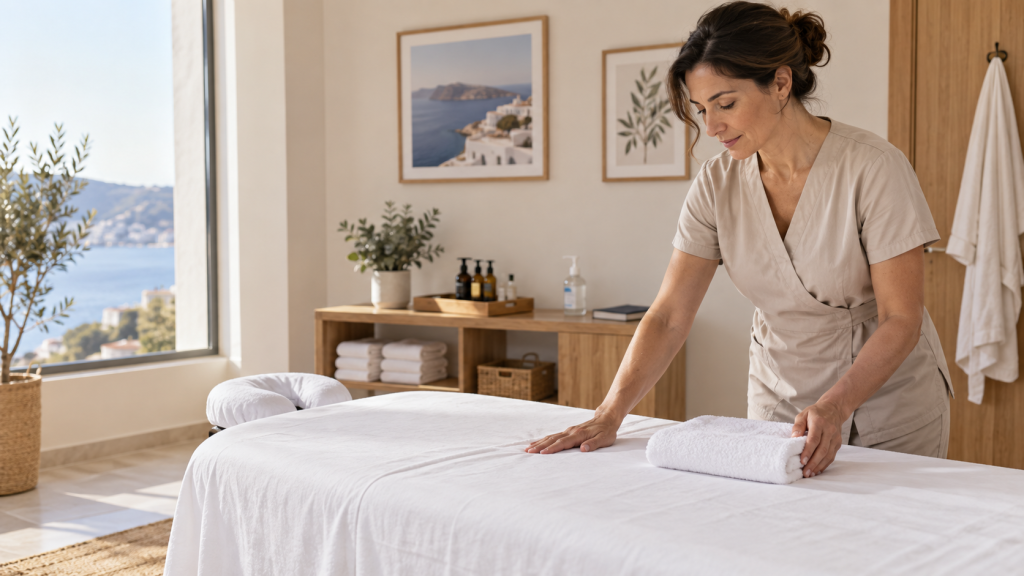
Clean sheets and towels, a neatly made bed, fresh air, the right temperature, and a tidy space allow guests to truly relax.
A space doesn't have to be luxurious. It just needs to be well-maintained.
Excessive decoration, strong scents, or very loud music do not necessarily create a better experience. Sometimes the greatest luxury is simplicity, tranquility, and the feeling that everything is in its place.
Respect for personal boundaries
Before the session begins, the professional needs to explain what will happen and listen to what the client needs.
What pressure level does he prefer?;
Is there any area where you would prefer not to have a massage?;
Does he feel any pain or discomfort anywhere?;
Is there anything a professional should know?;
Consent is not given just once, and it should not be taken for granted simply because an appointment has been scheduled. The client may at any time ask for a change in pressure, express discomfort, or ask to stop the session.
A truly good professional isn't bothered by this. He listens, adapts, and shows respect.
Confidentiality
During a massage, people sometimes relax and talk more. They may mention personal difficulties, stress, or situations in their lives.
Whatever a client shares within the session must remain there.
A professional may listen empathetically, but does not need to take on the role of a doctor, psychologist, or counselor. Knowing the limits of their role does not diminish their value. It strengthens it.
Consistency
Consistency isn't particularly impressive, but it is one of the strongest elements of a professional relationship.
The appointment should start on time.
The agreed-upon duration must be observed.
The cost should not be changed without notice.
The customer should be notified promptly if any changes occur.
A beautiful setting or good technique can hardly make up for the impression left by inconsistency. The customer needs to feel that their time and presence are valued.
A professional doesn't have to promise everything
The seriousness of the matter is also evident in the way a professional talks about what they can and cannot offer.
It is not necessary to present every session as a solution to every problem. Nor is it necessary to make grand promises to convince the client to schedule an appointment.
Massage has its own intrinsic value. It can provide relaxation, rest, care, and a welcome break from the stress of everyday life. It doesn’t need to do anything else to be considered important.
And when there is an issue that requires different or specialized care, referring the patient to the appropriate professional is a sign of expertise, not weakness.
Even before the first touch, a relationship has already been formed
When a client feels that they have been properly informed, that the space is clean, that their boundaries will be respected, and that they are dealing with a reliable person, they can relax into the session with greater confidence.
In that case, a massage is not just a series of proper movements. It becomes a holistic wellness experience.
Because professionalism isn't just about your hands.
It shows in the way you communicate.
In the space you've prepared.
Based on the information you provide.
Within the limits you respect.
In the promises you choose not to make.
And all of these have already spoken on your behalf before the session has even begun.
The Massage in Greece It helps massage therapists clearly present their training, experience, and services so that everyone can make a more informed choice.